
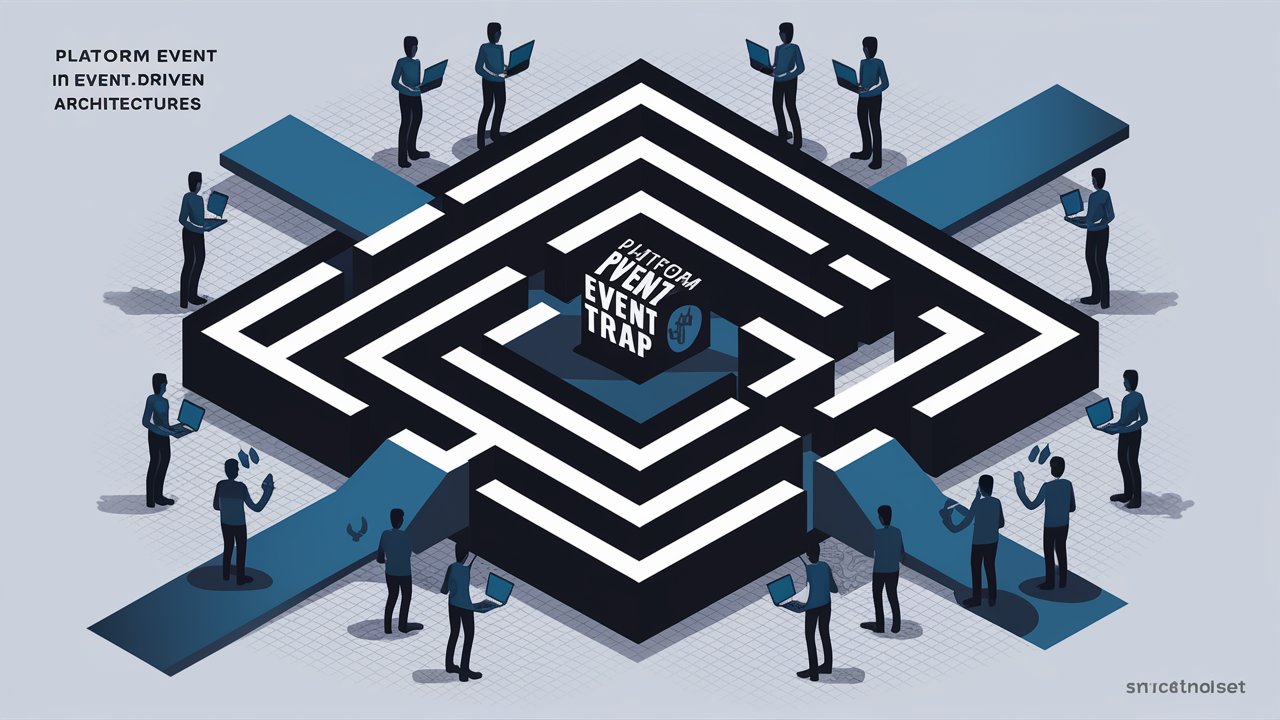
In modern distributed systems, platform events have become the backbone of scalable, loosely coupled architectures. Organizations rely on event-driven models to enable real-time processing, seamless integrations, and resilient microservices. However, beneath this architectural elegance lies a critical risk known as the platform event trap—a structural weakness that can silently degrade performance, compromise data consistency, and create operational instability.
We must understand that the platform event trap does not occur because events are flawed; it occurs because event ecosystems are often implemented without strategic governance, lifecycle control, and architectural discipline. In this comprehensive guide, we dissect the platform event trap, define its technical roots, analyze its impact, and provide a structured framework to eliminate it permanently.
Understanding the Platform Event Trap
The platform event trap emerges when organizations over-rely on event-driven communication without establishing strict design boundaries. Events begin as a clean integration layer, but gradually they evolve into a tangled network of undocumented dependencies, uncontrolled subscriptions, and unpredictable processing flows.
In such environments, events become invisible coupling mechanisms. Instead of reducing system dependencies, they obscure them. Teams lose visibility into which services consume which events, how many downstream processes are triggered, and what unintended side effects occur when event payloads change. The result is architectural fragility masked by asynchronous communication.
This trap often manifests in systems that scale quickly without implementing event governance. As event publishers and subscribers multiply, system observability declines. Debugging becomes difficult because failures propagate silently across asynchronous chains. Over time, what was designed as a decoupling mechanism transforms into a distributed risk multiplier.
Common Variations of the Platform Event Trap
To address this risk comprehensively, we identify multiple forms of the platform event trap that commonly appear in enterprise architectures.
1. Event Overproduction Trap
In this scenario, teams publish excessive events for minor state changes. Instead of consolidating meaningful domain events, they emit granular technical events that flood the platform. This creates:
-
Increased processing overhead
-
Subscription sprawl
-
Difficult event lifecycle management
-
Escalating infrastructure costs
When every internal change becomes a broadcast event, systems lose clarity around what truly matters.
2. Hidden Dependency Trap
Events are often marketed as loosely coupled mechanisms, yet subscribers create implicit dependencies. When a publisher modifies the event schema, downstream services may break silently. Without strong versioning and schema validation, this hidden dependency trap introduces unpredictable production failures.
3. Event Replay and Retention Trap
Many platforms retain events for replay and recovery purposes. However, if retention policies are not strategically configured, replaying historical events can:
-
Trigger outdated workflows
-
Duplicate transactions
-
Reprocess obsolete data
This creates systemic inconsistencies that are difficult to reverse in distributed environments.
4. Monitoring and Observability Trap
Without centralized logging, distributed tracing, and event lineage mapping, diagnosing failures becomes complex. Events move asynchronously, often across multiple services. When a downstream error occurs, tracing the original source event may require navigating multiple systems manually.
This observability gap defines a core dimension of the platform event trap.
Technical Causes of the Platform Event Trap
To eliminate the trap, we must examine its structural causes.
Lack of Event Governance
Organizations frequently implement event platforms without establishing governance committees, schema registries, or domain ownership rules. Without defined event taxonomies, duplication and ambiguity proliferate.
Absence of Schema Versioning
Event payload changes without version control are catastrophic in distributed systems. When consumers expect a specific structure, even minor schema adjustments can cascade into failures.
Improper Idempotency Handling
Event-driven systems must be idempotent by design. Without idempotent processing, replayed or duplicate events create data corruption, inconsistent states, and financial discrepancies.
Unbounded Subscription Growth
As services grow, event subscriptions increase organically. Without architectural review, subscriptions become permanent and undocumented. Removing or modifying events becomes nearly impossible due to fear of breaking unknown consumers.
Impact of the Platform Event Trap on Enterprise Systems
The platform event trap affects performance, security, compliance, and scalability simultaneously.
Operational Instability
When event chains become complex, system latency increases. Event storms may overwhelm message brokers. Backlogs accumulate, causing processing delays that ripple across dependent services.
Data Integrity Risks
If event ordering is not guaranteed or replay logic is flawed, inconsistent system states emerge. Distributed transactions become unreliable, increasing reconciliation workloads.
Security Vulnerabilities
Events often carry sensitive payloads. Without strict access controls, unauthorized subscribers may access confidential information. Furthermore, insufficient encryption and validation expose systems to injection or manipulation risks.
Increased Maintenance Costs
As event networks grow without documentation, onboarding new engineers becomes slower. Refactoring becomes risky. Maintenance costs escalate due to architectural opacity.
Strategic Framework to Avoid the Platform Event Trap
We implement a proactive framework to prevent event-driven architectures from collapsing into complexity.
1. Establish Clear Event Domain Boundaries
Every event must represent a meaningful domain occurrence. We define strict boundaries:
-
Events represent business facts, not technical state changes
-
Each domain owns its event taxonomy
-
Event names follow standardized conventions
This reduces redundancy and enhances clarity.
2. Implement Robust Schema Versioning
We enforce backward-compatible versioning strategies:
-
Introduce version fields within event payloads
-
Maintain compatibility windows
-
Deprecate obsolete versions systematically
This prevents consumer disruptions during publisher evolution.
3. Enforce Idempotent Consumer Design
Consumers must safely process duplicate or replayed events. We achieve this by:
-
Using unique event identifiers
-
Tracking processed event logs
-
Designing operations that tolerate repetition
Idempotency transforms event replay from a risk into a resilience mechanism.
4. Deploy Centralized Observability Systems
We integrate distributed tracing and logging systems that map event lineage. This allows us to:
-
Trace event origins
-
Monitor subscriber execution times
-
Identify bottlenecks rapidly
Visibility neutralizes hidden coupling.
5. Govern Subscription Lifecycle
We maintain a centralized registry of subscribers. Before modifying or deprecating an event, we analyze all dependencies. This governance model prevents accidental service disruption.
6. Limit Event Granularity
We prioritize business-driven events over technical noise. Instead of publishing every internal state update, we aggregate meaningful domain milestones. This reduces traffic and improves semantic clarity.
Architectural Best Practices for Sustainable Event Platforms
To build durable systems, we embed event architecture within enterprise design principles.
Event Documentation as Code
We treat event definitions as version-controlled artifacts. Every change undergoes review. Documentation remains synchronized with production reality.
Security-First Event Design
We apply encryption in transit, role-based subscription access, and payload validation. Sensitive data is minimized within events, and personally identifiable information is masked or tokenized.
Backpressure and Rate Limiting Controls
We configure message brokers with rate limits and queue depth monitoring. Backpressure mechanisms prevent event storms from overwhelming downstream systems.
Automated Contract Testing
Publisher and subscriber contracts are tested automatically before deployment. This ensures compatibility and reduces regression risks.
Why Organizations Fall Into the Platform Event Trap
Rapid digital transformation initiatives often prioritize feature delivery over architectural discipline. Event-driven patterns appear lightweight and flexible, encouraging teams to bypass structured governance. As product velocity increases, architectural entropy accumulates unnoticed.
We counter this by embedding architectural oversight within development workflows. Event-driven architecture is powerful—but only when governed with precision.
Conclusion
The platform event trap is not a failure of event-driven architecture; it is a failure of architectural governance. When events are unmanaged, undocumented, and loosely controlled, they become hidden coupling mechanisms that compromise scalability and reliability.
By implementing strict domain ownership, schema versioning, idempotent processing, observability integration, and subscription governance, we transform event ecosystems into resilient, transparent, and high-performance infrastructures. The key is discipline, visibility, and structured evolution.
A well-governed event platform accelerates innovation. An unmanaged one silently erodes stability. We choose architecture over entropy.
Frequently Asked Questions (FAQ)
What is a platform event trap?
The platform event trap refers to architectural risks that arise when event-driven systems lack governance, version control, observability, and lifecycle management, resulting in hidden dependencies and operational instability.
How does the platform event trap affect scalability?
Uncontrolled event publishing and subscription growth increase system complexity, create processing bottlenecks, and amplify latency across distributed services.
Can replayed events cause system failures?
Yes. Without idempotent consumer design and proper retention policies, replayed events may duplicate transactions, trigger outdated workflows, or corrupt data states.
What is the most effective way to prevent the platform event trap?
Implement domain-driven event design, schema versioning, centralized observability, subscription governance, and automated contract testing.
Are platform events still recommended in modern architectures?
Absolutely. When properly governed and architected, platform events enable scalable, decoupled, and real-time systems with high resilience and flexibility.